

profit factor in trading strategy
Performance Summary Tab
This tab displays whol available performance metrics for the strategy including Net Net profit, Margin, Max Drawdown and more. Information technology looks like this:
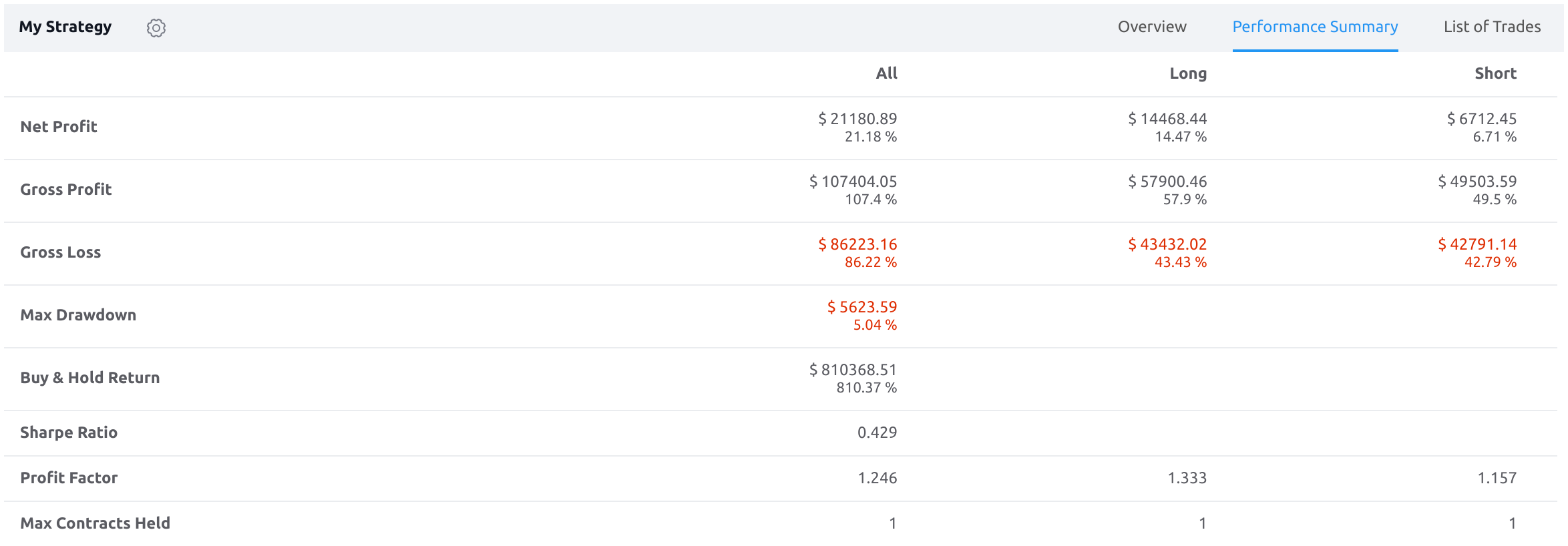
The performance metrics calculated for all trades are shown in the Completely column. Values deliberate only for long and short trades are shown in the Long and Suddenly columns, respectively. Now let's dive into what each carrying out rhythmical agency.
Net income
The overall profit operating theater loss (in the selected currency) achieved by the trading strategy in the test period. The value is the sum of all values from the Net profit pillar (connected the List of Trades tab key), attractive into story the sign.
Margin
The unconditioned profit for all gainful trades generated by a strategy.
Double-dyed Loss
The add together losses for all losing trades generated by a strategy. Analyzing and reducing sell losses is an extremely important part of trading scheme analysis. That's wherefore this distinguishing of a scheme is the most important. It should personify noted that clear profit increases non only if egregious profit improves, just also when gross departure is reduced.
Easy lay Drawdown
Displays the superlative passing drawdown, i.e. the greatest manageable loss the strategy had during its run compared to its highest profits.dannbsp;To calculate the Scoop Drawdown that is displayed in the Overview tablet in the Strategy Tester, we:
1. Work out resulting Equity later on each trade that the scheme closes, at the blockade where it squinched.
2. For apiece separate trade, calculate Max Equity at the time the trade closed. To do so, we take the strategy's Initial Capital letter anddannbsp;complete of the Equity values from the trades that were already closed at that point and find the largest number among these values.
3. For each trade, calculate its own Drawdown. This is done by winning the deal out's Easy lay Equity (found in Gradation 2) and subtracting its current Equity (Step 1).
4. Take individual Drawdowns of all trades (Step 3) and find the largest number among them.
Max Drawdown is the hardest the strategy falls, equity-wise, from its peaks. You can simplify its recipe as "Highest Equity of all time - Lowest Equity after the highest peak". You can roughly see this value on an equity slue graph past looking from the highest peaks to the lowest lowsdannbsp;moving forward. Let's deal how Max Drawdown is calculated:
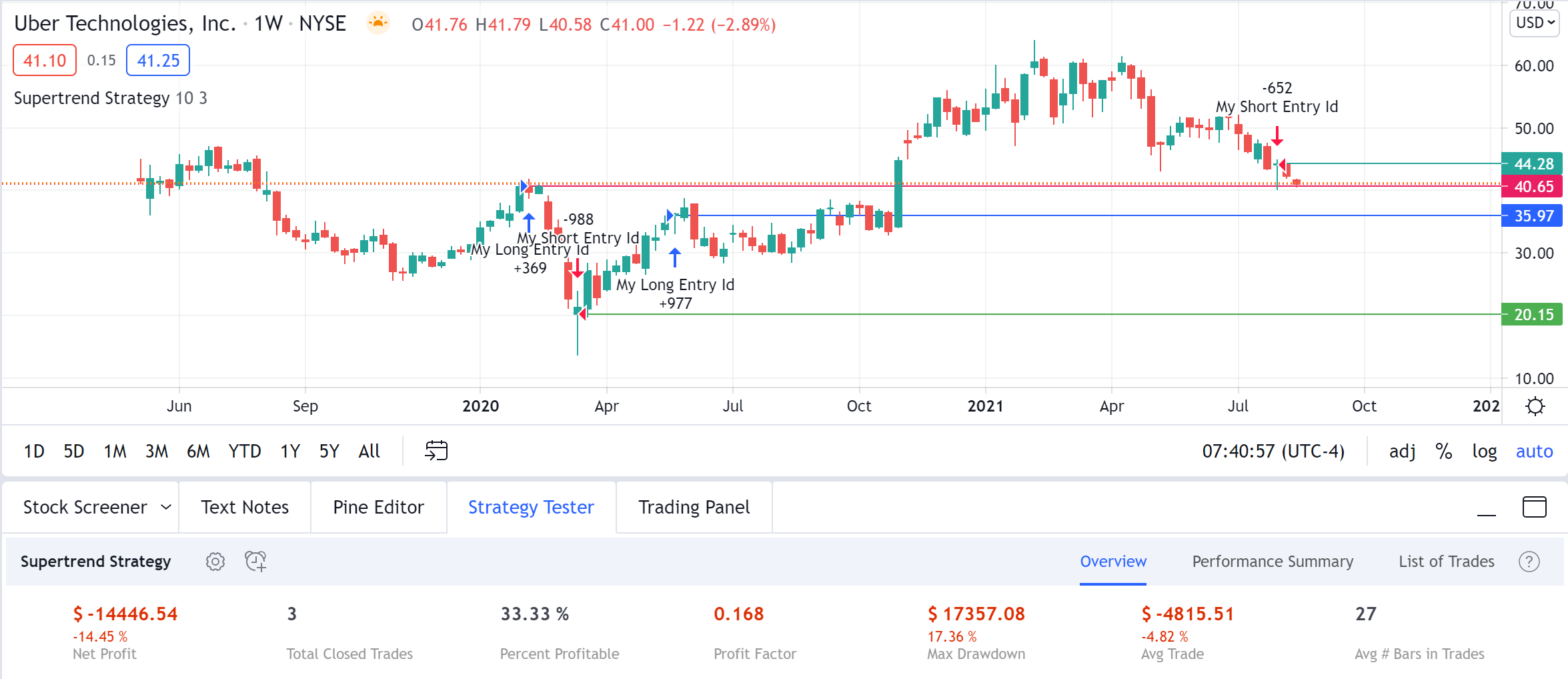
Start Fairness (i.e. the funds available to the strategy) is always equal to First Capital. In our case, it is 100000.
On our first deal, the strategy enters long and buys 369 contracts for 40.65 = buys 14 999.85 USD worth of stock.
Happening our second trade, the strategy gets a signal to reverse its position. To suffice so, we would take to sell our 369 long contracts (to get to 0 position size) and so deal some Sir Thomas More to have a short-dated put together. We trade 369 contracts at 20.15 = get 7 435.35 USD. Our equity afterward this trade is 100000 - 14 999,85 + 7 435,35 = 92435.5 USD. Our new Grievous bodily harm Drawdown 100000 - 92435.5 = 7564.5 (it is automatically Max Drawdown because it is the only Drawdown respect we have).dannbsp;After getting to 0, we also short 988-369=619 stocks at 20.15, effectively gaining 12472.85 USD (we short the stock, so we loan it and trade it expecting to buy it back later at a best toll).
On our third trade, we get the signalize to flip to long. To do that, we front deman to repurchase 619 stocks to close our chunky. The damage went up, so it costs US 619 * 35.97 = 22265.43. To covering our position, we've exhausted 22265.43 and exclusive earned 12472.85, so our loss for this trade is 9792.58. Our equity at this step is 92435.5-9792.58 = 82642.92. This is the last point our equity has been at, sol our brand-new Scoop Drawdown is 100000 - 82642.92 = 17357.08.
After that, we go long at 35.97 and then turn the position at around 44.28. The accurate numbers are not important for us because this trade is actually profitable, therefore it increases Equity. Max Drawdown smooth stays tantamount to 17357.08 because IT is calculated settled on peaks and troughs of Equity, and on this particular trade, our Equity is non the least bit time low pressure.
The percentage and absolute values of a drawdown are two different metrics. They are tracked independently. For instance, let's state the first capital is $100. Afterwards a series of losing trades, fairness decreases to $50. The drawdown amounts to $50 in absolute terms and 50% in relative terms. Later, subsequently a series of profitable trades, equity increases to $300 then drops to $200. In this slip, the absolute drawdown will be $100, and the relative drawdown, 33%. The gross uttermost absolute drawdown of the strategy leave atomic number 4 $100, and the maximum relative drawdown will be 50%.
Note that drawdowns in the List of Trades are calculated other than. In Inclination of Trades, Drawdown is recalculated on each bar (so for each one trades drawdown represents maximum possible deprivation during the trade). In Overview, Max Drawdown is recalculated non happening each taproo only on each sealed trade.
Buy danamp; Hold Recall
The return achieved if altogether funds (Initial Working capital) were used to buy the certificate when the first trade is entered, and the situation was held for the duration of the try period.
Sharpe Ratio
Nobel Laureate, William Sharpe, introduced the Sharpe Ratio in 1966 under the bring up "reward-to-variability ratio". The Sharpe Ratio is wide used by portfolio managers and private traders to show how much gamble was taken to achieve specific returns. The recipe for the Sharpe ratio is Strontium = (MR - RFR) / SD, where MR is the average homecoming for a period (monthly for a trading full stop of 3 operating theatre more months or daily for a trading period of 3 OR more days), and RFR is the unhazardous rate of return (by default, 2% annually). SD is the standard deviation of returns. Thus, this formula yields a appreciate that could be loosely defined atomic number 3 return per unit risked if we accept the premise that variability is risk. The higher Sharpe ratio, the smoother the equity curve. Having a smooth equity curve is an important objective for many traders.
Sortino Ratio
The Sortino ratio is a version of the Sharpe ratio. Dissimilar the Sharpe ratio, its calculation is cooked exploitation the orthodox deviation of the downside risk, instead than that of the total (upside + downside) risk. Referable this, it is intellection to give a better view of a portfolio's risk-keyed performance because convinced excitability is considered a benefit.
Profit Component
The amount of money a trading scheme made for all unit of money it lost (in the selected currentness). This value is calculated by disjunctive gross earnings by total losings.
Max Contracts Held
The level bes number of contracts held at any one time.
Open PL
The profit or loss for the current open position. If no position is open, the value returned is N/A.
Deputation Paid
The sum (in the selected currency) of deputation paid. Slippage is non included.
Absolute Closed Trades
The total number of closed trades (some winning and losing) generated by a scheme. The total number of trades is important for a number of reasons. First, the number should be large enough for strategy results to be of any applied math significance. Ordinal, the number bottom help corroborate that your strategy is trading at the frequency you anticipate.
Total Open Trades
The number of entries currently opened.
Number Winning Trades
The total number of winning trades generated by a strategy.
Routine Losing Trades
The total number of losing trades generated by a strategy.
Percent Productive
The percentage of winning trades generated by a strategy. Calculated aside dividing the number of winning trades by the total number of closed trades generated by a strategy. Percent profitable is non a very tried measure out by itself. A strategy could have many small winning trades, qualification the percent profitable high with a small average winning trade, or a few big successful trades accounting for a downhearted percent profitable and a big average winning deal. Whatever palmy strategies have a percent profitableness below 50% but are still profitable due to proper personnel casualty ensure.
Avg Trade
The amount of money gained or lost by the average swop generated by a strategy. Calculated by disjunctive the Profits by the overall number of closed trades. An important esteem since IT must be vast decent to cover the commission and slippage costs of trading the strategy and still bring a profit.
Avg Win Trade
The Gross Profit divided by the routine of Winning Trades generated aside a strategy.
Avg Red Merchandise
The Gross Loss divided by the number of Losing Trades generated past a strategy.
Ratio Avg Succeed / Avg Loss
The average value of how umpteen currency units you win for all social unit you fall back (in the selected currency). This is calculated by dividing the average attractive trade by the average losing trade. This field is non a very meaningful value by itself because it does not allow the ratio of the numeral of victorious vs losing trades, and strategies can cause diametrical approaches to profitability. A strategy may trade at every possibility in order to charm many small profits, up to now have an common losing swap greater than the average winning trade. The higher this value is, the punter, but it should be considered together with the percentage of winning trades and the net profit.
Largest Win Swap
The most profitable sell in the trial period.
Largest Losing Trade
The most losing trade in the test period.
Avg # Bars in Trades
The average numeral of parallel bars that elapsed during trades for all closed trades.
Avg # Bars in Winning Trades
The average number of parallel bars that elapsed during trades for whol winning trades.
Avg # Bars in Losing Trades
The average amoun of bars that elapsed during trades for all losing trades.
Margin Calls
The summate number of margin calls generated by a strategy.
Overview lozenge
This tab provides key performance metrics for the strategy.

At the topmost of the tab are the metrics of the same make from the Performance Summary tab. The following charts are placed in the center:
Drawdown
This chart illustrates each trade's drawdown vs. swop number for all closed trades.
Equity
This graph displays the fairness (in the selected currency) vs. swap keep down for all compressed trades. The equity curve line chart presents trading performance on a trade wind-away-trade basis. This all-purpose fairness chart is unsurpassable used for general analysis of trading carrying out.
Bdanamp;H
This graph displays the riposte achieved if all funds (Initial Capital) were in use to corrupt the certificate when the prototypic trade is entered, and the position was held for the continuance of the test period. You can hide out/show graph elements by clicking on their corresponding push button at the hindquarters of the tab.
List Of Trades Tab
This tab displays detailed information on each trade.
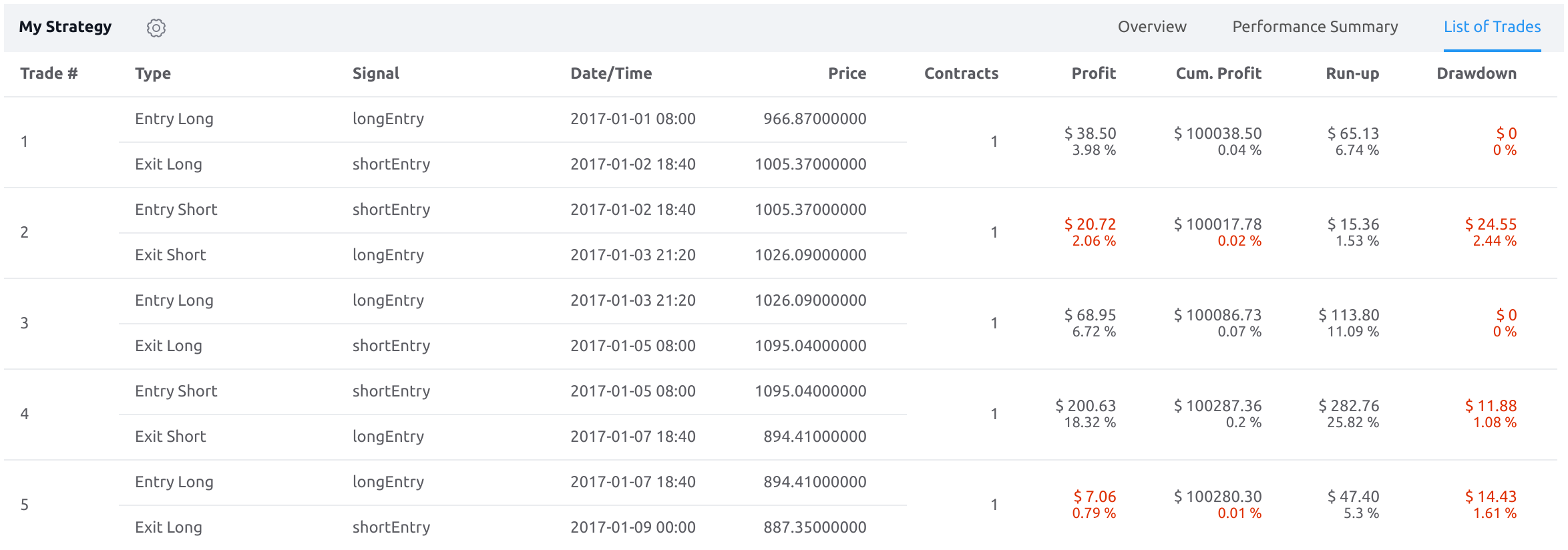
A trade is a pair of orders: an entry regularise and an snuff it Order. Trades are arranged chronologically past execution of entry orders. The soonest trade is at the very top of the tilt.
Trade #
Contains the sequential number of the trade.
Type
The instruction of the trade (farseeing or truncate).
Signalize
The identifier of the order old to open or immediate the trade. An identifier is a chain measure assigned to the id argument of one of the favourable functions: strategy.introduction, scheme.order, strategy.exit, scheme.close and strategy.close_all.
Escort/Time
The transaction time in the chart's time zone.
Toll
The execution price.
Contracts
The number of units bought OR sold.
Profit
The profit per trade and the acquire/loss pct of that trade.
Cumulative Profit
The additive profits or losings of the strategy after closing the trade. The percent displays the relative gain/loss of the last swop as compared to the equity (first capital + cumulative gain) in front that swap.
Run-up
The level bes possible profit of the trade according to the strategy, as well arsenic the supreme percentage gain.
Drawdown
The supreme possible expiration of the trade according to the scheme, as comfortably as the maximum percentage personnel casualty.
Let's consider how the values for the Profit, Cumulative Profit, Run-up, and Drawdown columns are calculated:
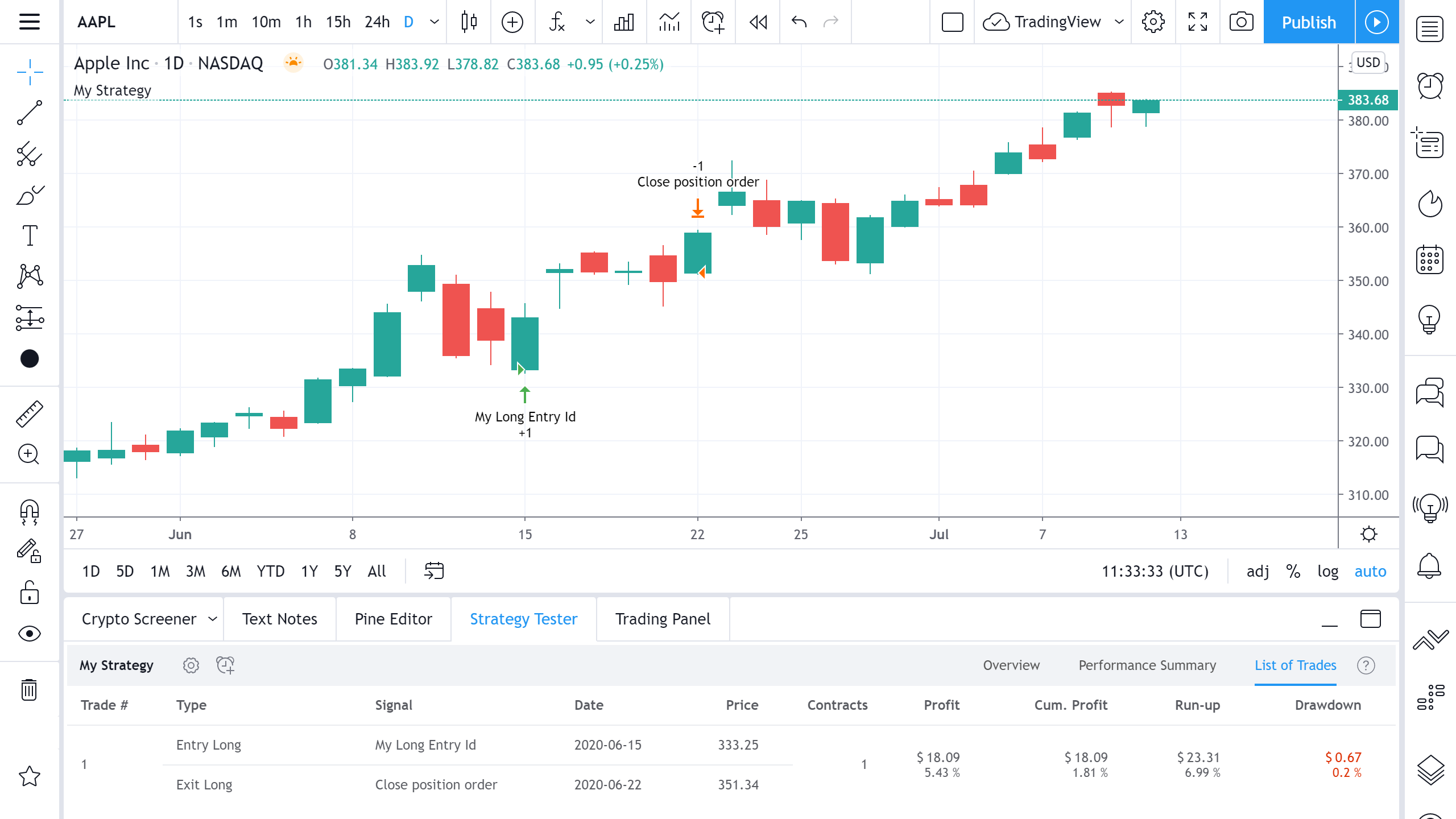
Therein good example, we bought 1 share of AAPL at the opening along June 15 and sold it at the opening of June 22. The initial capital was $1000.
Net profit
We bought a stock at $333.25 and sold for $351.34, i.e. profit amounted to (351.34-333.25) = $18.09, or as a percent (18.09/(333.25*1))*100% = 5.43%.
Accumulative Profit
Cumulative net income is deliberate away adding up whol previous Cumulative Profit values with the current Profit respect. In this case, we sole have one trade, so the Cumulative Net profit will be $18.09,dannbsp;adequate Profit. Cumulative Profit Pct value takes the First Capital into its calculation and is calculated with the formula: Cum. Profit % = Profit/(Initial Capital+Accumulative Profit of the previous trade)*100% = 18.09/(1000+0)*100 = 1.81%.
Run-Up
The upper limit price reached during the trade wind was $356.56 on June 19, thus the maximum achievable earnings in this transaction is $356.56 - $333.25 = $23.31, for a percentage of (23.31/(333.25*1))*100% = 6.99%.
Drawdown
The minimum value to which the share Leontyne Price has decreased since the purchase is $332.58 on June 15, therefore the uttermost possible loss therein dealings is $333.25 - $332.58=$0.67, for a percentage of (0.67/(333.25*1))*100% = 0.20%.
profit factor in trading strategy
Source: https://www.tradingview.com/support/solutions/43000561856-how-are-strategy-tester-report-values-calculated-and-what-do-they-mean/
Posted by: sinquefielddents1951.blogspot.com
0 Response to "profit factor in trading strategy"
Post a Comment